Why Does My Record Skip? Dust, Static, Scratches, or the Turntable
Updated on
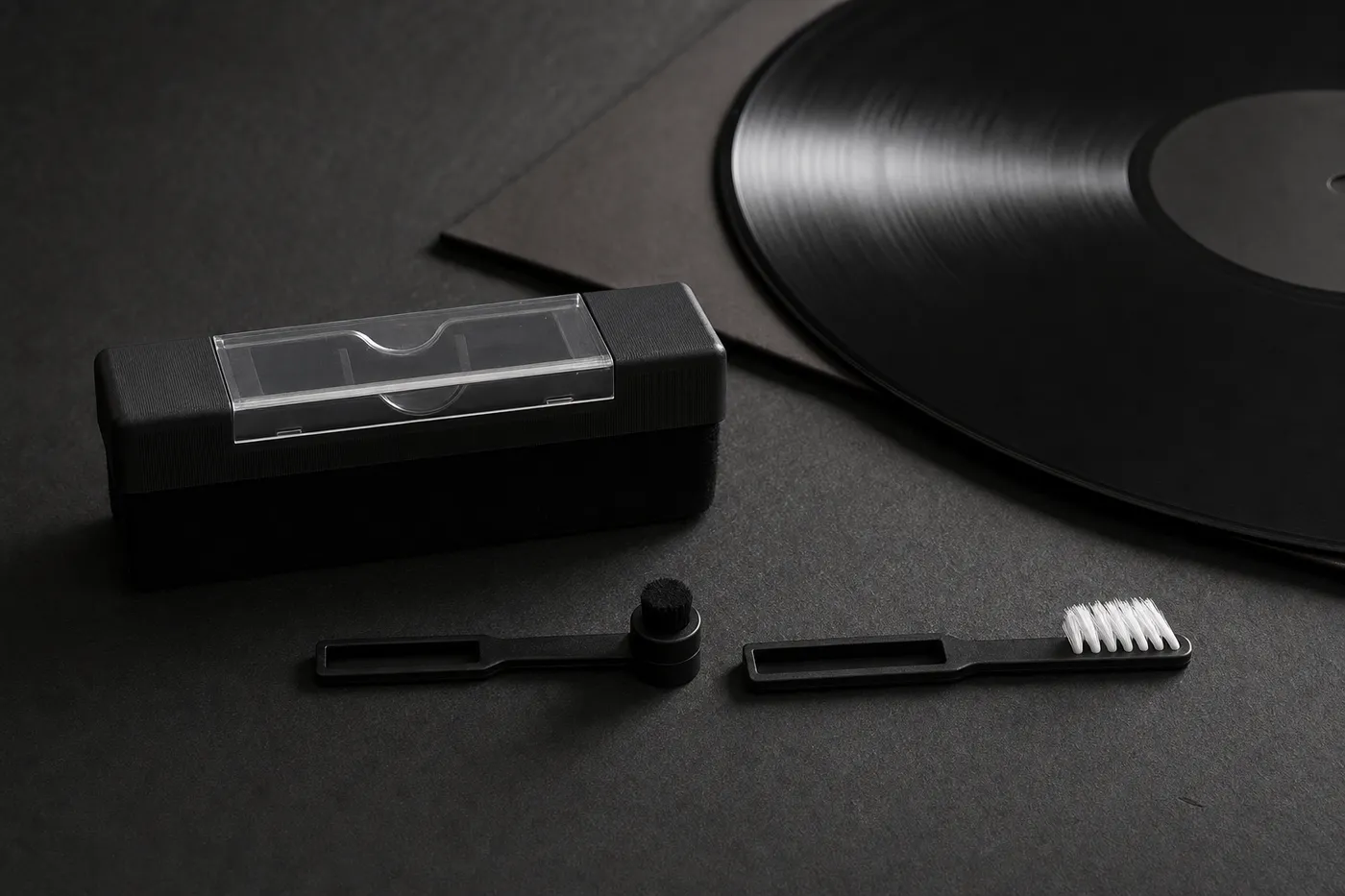
A record that skips tells you one thing: at some point in the groove, the stylus lost the wall it was tracing and landed somewhere else. It does not tell you why. The same jump can come from a tuft of lint, a fiber wound around the cantilever, a scratch, a disc that no longer lies flat, or a tonearm set too lightly. This guide sorts the skip by its symptom first, then takes the causes one at a time: what each looks like under a lamp, what removes it, and where the two brushes in our set do their part. Two causes come off with a brush before the side plays. The other two live on the shelf and in the tonearm.
Read the skip before you touch anything
The stylus stays in the groove because the walls hold it sideways and the tracking force presses it down. Anything that lifts the tip clear of both, lint, a ridge of displaced vinyl, the crest of a warp, lets it leave. Thrown inward it jumps ahead; thrown outward it replays the turn it just finished, and if the same ridge throws it again, the record locks. What moves from play to play is loose. What sits at the same bar is fixed in the vinyl. What happens on every record is on the deck.
| Symptom | Points to | First move |
|---|---|---|
| One record, same bar every play | A scratch or a pressing fault | Raking light: a straight line across the grooves confirms it |
| A click or stutter that moves, or is gone on the second play | Loose dust or lint in the groove | One pass with the velvet block, platter turning |
| Every record skips, worst in loud passages near the label | A loaded or worn stylus | Three back-to-front strokes with the stylus brush |
| The arm rises and falls, one skip per revolution | A warped disc | Sight along the surface; the fix is storage |
| Skips when someone walks past or the volume goes up | Vibration reaching the deck | Move the deck off the speakers' surface |
| Many records skip after the deck was moved or a cartridge fitted | Tracking force, anti-skate or level | Reset both to the cartridge's published figures, level the platter |
Work through it in cost order. The first two moves take under a minute and, when the cause is loose material, end the search. Then play a record you know is clean and flat: if that one skips too, the fault is on the deck.
Dust, lint, and the static that recruits them
"The finer groove means dust particles are comparable in size with the stylus and cause clicks and pops"
— IASA TC-04, section 5.3, 2009
The archive guidance describes a click, and a click is the ordinary case. A skip is the same event with a larger object: a fiber shed by a paper sleeve, lying across the grooves, is a bridge the tip rides up with no wall on either side. The test for dust is repetition. Sweep the disc, play the passage again, and a dust skip is gone or has moved, because the material that caused it is now in the velvet. A skip that stays at the same bar after a sweep belongs in the section on scratches.
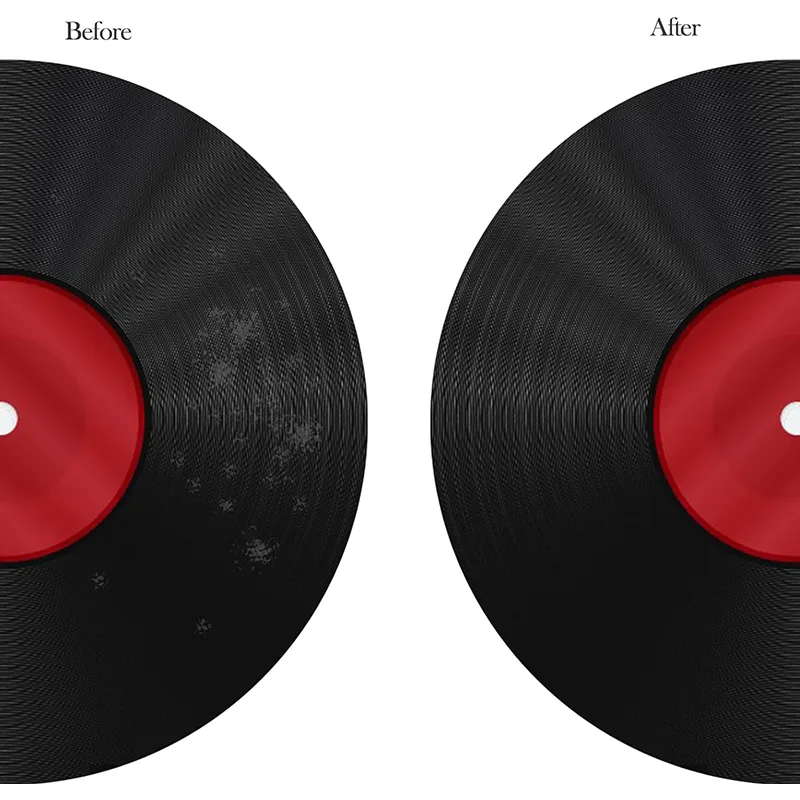
The velvet lifts by contact: loose material that meets the dense pile drops between the fibers and stays there instead of being pushed ahead of a bristle. The face is 4.9 in (12.5 cm) long, so one pass with the platter turning covers the full radius of a side. A dry sweep handles what is loose. Grime pressed into the groove by years of play needs the wash in how to clean vinyl records, and a pad that has swept a hundred sides needs emptying with the white detail brush to go on lifting.
Static is the reason a record swept last week skips today. It does not throw a stylus out of a groove; it pulls airborne dust onto the disc and holds it there, and every trip through a paper sleeve adds to the charge. The archive guidance names it as the second reason dust is a bigger problem on LPs than on any earlier format.
"The electrostatic nature of vinyl increases the attraction of dust to the surface of the disc"
— IASA TC-04, section 5.3, 2009
Sweep with the platter turning instead of scrubbing back and forth, lift the block straight up instead of dragging it to the label, and sleeve the record in an anti-static inner in place of the paper it came in. What the velvet face does about charge, and what it does not, is on the anti-static record brush page; the sleeve and the room are in how to store vinyl records.
A loaded stylus
This is the cause people find last, because the record looks fine. The giveaway is that it happens on every disc, and worst on the inner grooves, where the music is packed tightest and a tip sitting high on a collar of debris finally loses the walls.
(15-25 µm) the range of replay styli IASA lists for microgroove LPs, from 25 µm on early mono LPs down to 15 µm, small enough that a single sleeve fiber sitting on the tip is a large object
— IASA TC-04, section 5.3, 2009
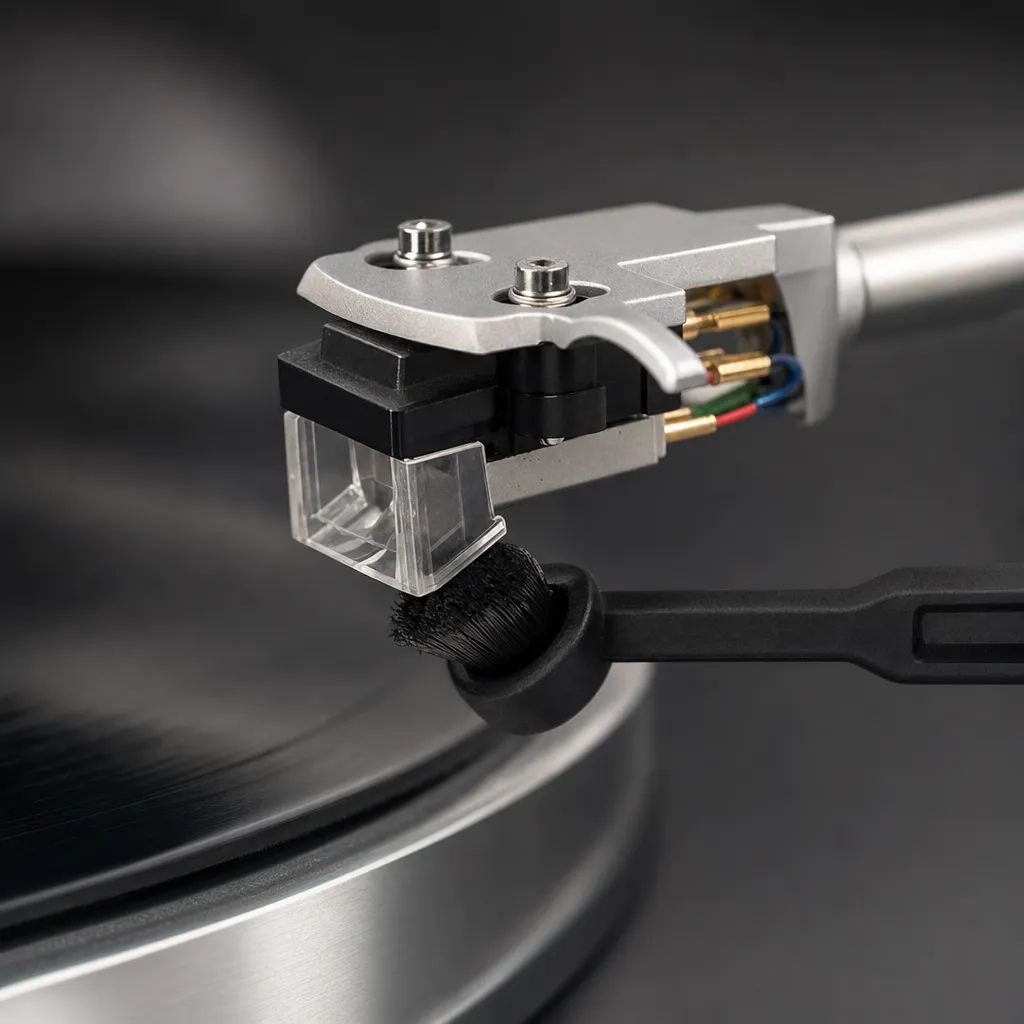
The stroke is the whole method: from the rear of the cartridge toward the tip, in the direction the record travels, lifting away at the end, never sideways and never backwards. A small light and a phone camera in macro mode show a clean tip as a bright point and a loaded one as a grey collar. The angled stylus brush in our set is bent near the tip so the round head of black bristles reaches the diamond from behind. The full routine is in how to clean a record player needle, and the piece itself is on the stylus brush page.
One case sits past any brush: a diamond played beyond the hours published for its tip shape is worn, and a worn tip mistracks in the same loud passages a dirty one does. If record and stylus are both clean and the skip stays, the hour count is next.
Scratches and groove damage
The lamp settles it. Grooves run in a spiral, so under raking light the surface reads as fine concentric rings. A scratch cuts across those rings as a straight line, usually radial, because most scratches come from a disc dragged across an edge on its way in or out of a sleeve. A hairline that catches the light but does not skip is cosmetic. A line you can feel with a clean fingernail is a ridge the tip will not clear.
What happens next is mechanical. The one thing that changes whether a stylus rides across a light scratch is the tonearm: tracking force at the top of the cartridge's published range holds the tip over a ridge that throws it out at the bottom of that range. A deep scratch is a deep scratch, and the passage is lost. Cleaning keeps its ordinary job: dust settles into the scratch and the grooves either side of it, and the crackle around the skip does go away with a sweep. If the record is quiet after cleaning, the noise was dirt.
A record that does not lie flat
Sight along the surface at eye level with the platter turning and a warp shows as a rise and fall at the edge. An edge warp lifts one side of the disc; a dish warp bows the whole disc. Both come from a stack pressing on the records at the bottom, a half-empty crate letting discs lean for a season, or an afternoon of direct sun.
"Shelve discs such as LPs, 45s, and 78s vertically and in their sleeves/albums. Do not stack discs on top of one another."
"a laboratory style oven is mandatory, a domestic oven is not appropriate" for flattening a warped disc, which IASA calls the most frequently needed restoration of a disc recording
— IASA TC-04, section 5.3, 2009
At home, a mild dish warp often plays once the disc is held flat to the platter, and an edge warp can sometimes be tracked at the top of the published force range, the same lever as a scratch. Beyond that, the disc is what it is, and the rest of the collection is protected by the shelf. How to store vinyl records covers it.
The turntable: tracking force, level, and footsteps
Tracking force is the down-pressure the counterweight leaves on the stylus. Too little and the tip rides high in the groove, where any bump, ridge or fiber ejects it. Too much and the tip wears the groove walls. Every cartridge ships with a published range, and the figure archives quote for their own replay work gives the scale.
(about 1.5 grams) tracking force IASA quotes for the high-compliance cartridge it recommends for LP replay; the figure to set is the one published for your cartridge
— IASA TC-04, section 5.3, 2009
Set it with the arm balanced first, then dialed to the published figure, and check it against a stylus scale if you have one, because a knocked counterweight reads one thing and delivers another. Anti-skate is the small outward force that cancels the arm's pull toward the spindle; on most arms it is set to the same number as the tracking force, and the arm's manual has the final word. Level asks for a bubble level on the platter itself: a slope adds a constant sideways push to the stylus.
The fourth cause comes from outside the deck. A stylus holding a groove under a gram or two of force has no defense against the shelf moving under it: a footstep on a sprung floor, a door closing, or speakers on the same surface feeding their bass back into the plinth. If the skip arrives when somebody walks past, or only at high volume, the fix is where the deck stands: a wall shelf on masonry, a heavier stand, or more distance from the speakers. The monthly pass in the vinyl record care routine is the moment to check all four.
Short answers
Can a dirty record cause skipping?
Yes, and it is the case a listener fixes at home in under a minute. A tuft of lint or a clump of dust in the groove lifts the stylus clear of the wall. Sweep the disc with the velvet block, play the passage again, and a dust skip is gone or has moved.
Why does my record skip in the same place every time?
Because the cause is fixed in the disc. A scratch is a ridge of displaced vinyl at one bar, and a warp lifts the arm at one point of every turn. Under a lamp, a scratch is a straight line across the grooves; a warp shows when you sight along the surface with the platter turning. Neither moves after cleaning.
Which skips does a record cleaning brush fix?
The ones caused by loose material: dust and lint on the disc, which the velvet block lifts before the side, and dust or a fiber on the stylus, which the angled stylus brush clears in three strokes. A scratch, a warp and a tonearm set wrong are mechanical, and the sections above say what corrects each.
The two causes you can remove before the side plays
Of the four reasons a record skips, the two you can clear at home in under a minute are loose material in the groove and a loaded stylus, and those are the two jobs the set was built around: the velvet block for the disc before every side, the angled stylus brush for the diamond, and the white nylon detail brush that keeps the velvet empty. See the three pieces on the record cleaning kit page, or read what buyers reported on the reviews page.
More guides: all Tonebrush guides · how to clean vinyl records · cleaning a record player needle · carbon fiber vs velvet · how we test · about Nick Talbot