Stylus brush: the one stroke that protects your cantilever
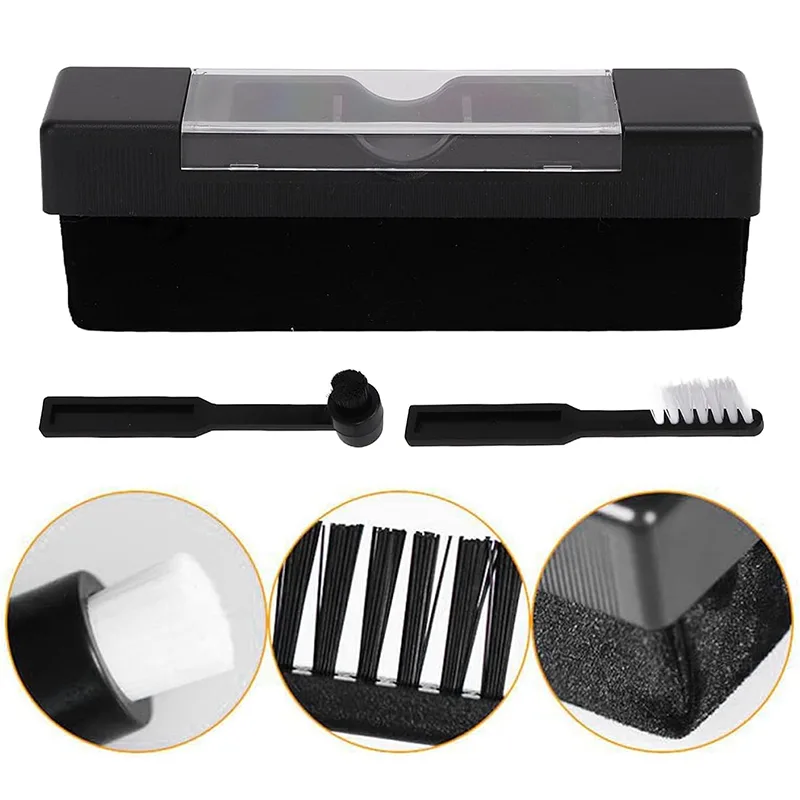
Which piece is the stylus brush
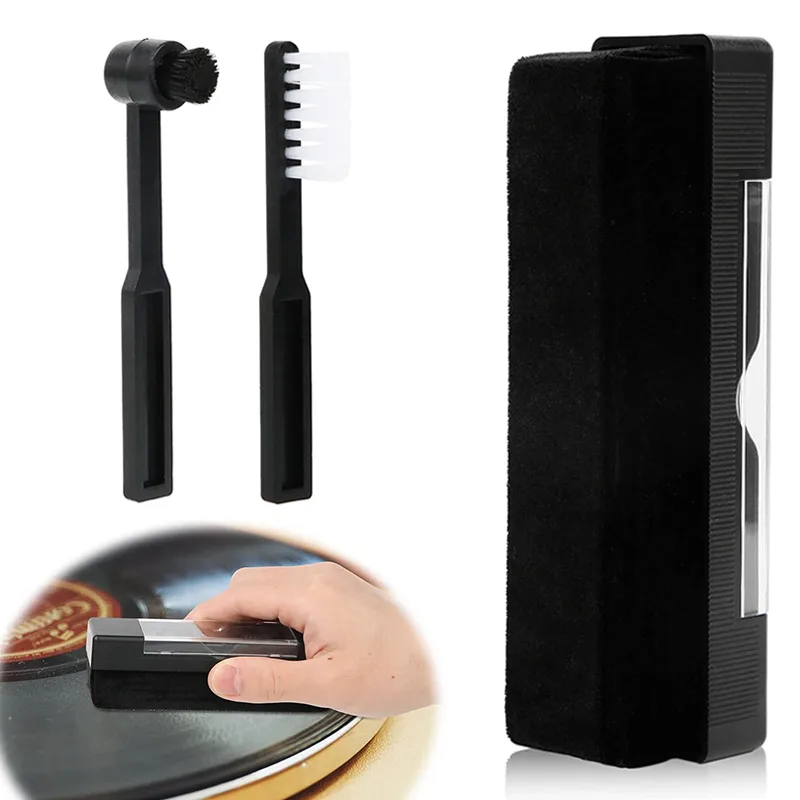
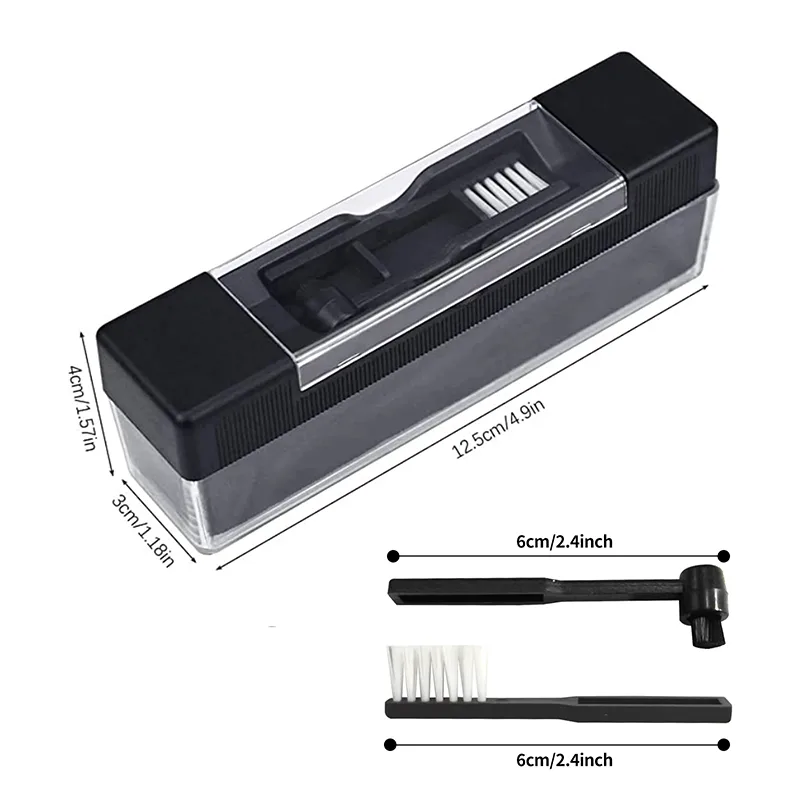
Do not confuse it with the third piece. Both small brushes share the same flat handle and the same oval cut-out, and at a glance in a photo they look interchangeable. They are not. The stylus brush is the angled one with the black round head. The straight one with white nylon bristles is the detail brush, and it is for re-combing the velvet block, never for touching a cartridge.
The stylus brush stores in the back of the velvet block. That is a small design decision with a large practical effect, because the piece most likely to disappear into a drawer lives inside the piece that sits next to the turntable. The velvet block itself is covered on the anti-static record brush page.
Back to front, and nothing else
The reason is mechanical. A cantilever is a thin tube suspended in a compliant rubber joint, tuned to move in the groove's plane under a tracking force measured in fractions of an ounce. It is engineered to accept force along the direction of play. It is not engineered to accept lateral force applied by a stiff object from the side, and repeated sideways pressure is the classic way an amateur bends a cantilever or shifts alignment without ever noticing they did it.
Ortofon publishes the same rule in plain language: brush from the rear of the cartridge toward the stylus tip, never from the tip toward the rear, and never side to side. That is a cartridge maker protecting its own product, not a marketing line from a brush seller.
| Motion | Verdict | Why |
|---|---|---|
| Back to front, along the cantilever | The only correct stroke | Loads the suspension in the direction it is designed to move |
| Front to back, tip toward the body | Never | Pushes against the tip and can drive debris up into the assembly |
| Side to side | Never | Lateral force on a suspension built for vertical and forward motion |
| Circular or scrubbing | Never | Combines both wrong directions, repeatedly |
| Pressing harder for stubborn dust | Never | Tracking force is a fraction of an ounce; your hand cannot meter pressure at that scale |
One more habit worth building: turn the volume down or mute the phono input before you touch the cartridge. A brush against a live stylus sends a loud thump through the system, and on some speakers that thump is expensive.
How often, and when it matters most
Frequency also depends on what you feed it. A record that has just been swept with a dry cleaning kit hands the stylus far less to collect than one pulled straight from a thrift-store crate. If you are playing second-hand records that have never been washed, expect to brush more often and to see more on the bristles.
There is a symptom worth recognizing. If the sound turns dull and slightly distorted a few minutes into a side, then clears up after you clean, that was dust on the tip rather than a worn stylus. If cleaning changes nothing, the problem is somewhere else, and the article on cleaning a record player needle works through the rest of the checklist.
What never touches a stylus
A fingertip leaves oil. Oil is not neutral on a diamond tip; it collects dust faster than clean diamond does, so the wipe that felt effective makes the next hour worse. It also applies force with no control at all over direction.
Solvents are the more serious risk. On many cartridges the diamond is bonded to the cantilever with adhesive, and liquid that wicks up the shank can reach that joint. Ortofon does not recommend solvents of any kind for cleaning either a stylus or a record surface, which is the clearest possible guidance from a company that makes the part in question. If you choose to use a dedicated stylus fluid anyway, use the smallest amount the applicator will hold and keep it on the tip.
Canned air is the underrated hazard. The blast is strong enough to move the cantilever, and inverted cans spit cold propellant. Blowing with your mouth is worse still, because it deposits moisture on the assembly.
What buyers wrote about the stylus piece
Our count across the 47 written reviews in the buyer feedback record (July 2026). The overall score is 4.6 out of 5 across 151 ratings.
| Mentions of the stylus piece | Reviews | Share |
|---|---|---|
| Praised for cleaning the cartridge head | 2 | 4% |
| Complaint about receiving only the small brush | 1 | 2% |
| No mention of the stylus piece at all | 44 | 94% |
The single complaint came from a buyer who ordered through an older single-piece listing and received the stylus cleaner alone instead of the full set. It is a listing problem, not a product problem, and it is the reason every page here states the count: three pieces, one box.
Three numbers behind the rules
Playback life Audio-Technica gives for a stylus, depending on tip shape
Solvent types Ortofon recommends for cleaning a stylus or a record surface
— Ortofon, Protect your equipment, 2026
Tip radius of the standard stereo conical stylus, about 18 microns of diamond for dust to cling to
Where the stylus brush sits in the routine
That order is deliberate. Cleaning the stylus before cleaning the record just hands the freshly clean tip a dirty groove to run through. Combing the velvet last means the block goes back in its cover empty and is ready for tomorrow rather than carrying today's load into it.
The full weekly version, including what to do monthly and what to leave alone, is in the vinyl record care routine. If your records need more than a dry sweep before any of this is worth doing, start with how to clean vinyl records, then keep them that way with sensible storage.
Stylus cleaner questions
Which direction do you brush a stylus?
Back to front only, from the rear of the cartridge toward the tip, the same direction the groove travels under the stylus. Ortofon states it directly: use the brush from the rear of the cartridge toward the tip, never from the tip toward the rear, and never side to side. Sideways strokes load the cantilever suspension laterally, which it is not built to take.
How often should I clean the stylus?
A light pass before each side is the habit that keeps everything else simple. Ortofon suggests brushing along the cantilever whenever you play a new record or change sides. If you only remember once a week, do it once a week; the harm comes from dust that sits and hardens, not from the brushing itself.
Can I use alcohol or a cleaning fluid on the stylus?
We do not recommend it, and neither does Ortofon, which says it does not recommend solvents of any kind on a stylus or a record surface. On many cartridges the diamond is bonded to the cantilever with adhesive, and liquid wicking up the shank can reach that joint. A dry brush avoids the question entirely.
Can I just wipe the stylus with my finger?
No. Skin leaves oil, and oil on a diamond tip collects dust faster than the bare tip did. A fingertip is also far larger than the assembly it is pressing against, so the force lands wherever it happens to land. The brush head is sized to reach the tip without loading the cantilever sideways.
Does a clean stylus sound better than a worn one?
A clean stylus sounds like the stylus you own. It does not reverse wear. Audio-Technica puts stylus life between 300 and 1,000 hours of playback depending on tip shape, and past that point the diamond geometry itself has changed. Cleaning delays replacement, it does not cancel it.
Where to go next
- The three-piece record cleaning brush set — the full product page with specs and buyer photos.
- Record cleaning kit — the four kit categories and what each one costs.
- Anti-static record brush — what velvet does about static, and what it does not.
- How to clean a record player needle — the long version of this page.
- Vinyl record care routine — where each tool fits in the week.
- How we test — the bench behind these pages.