How to Store Vinyl Records So They Stay Flat and Quiet
Updated on
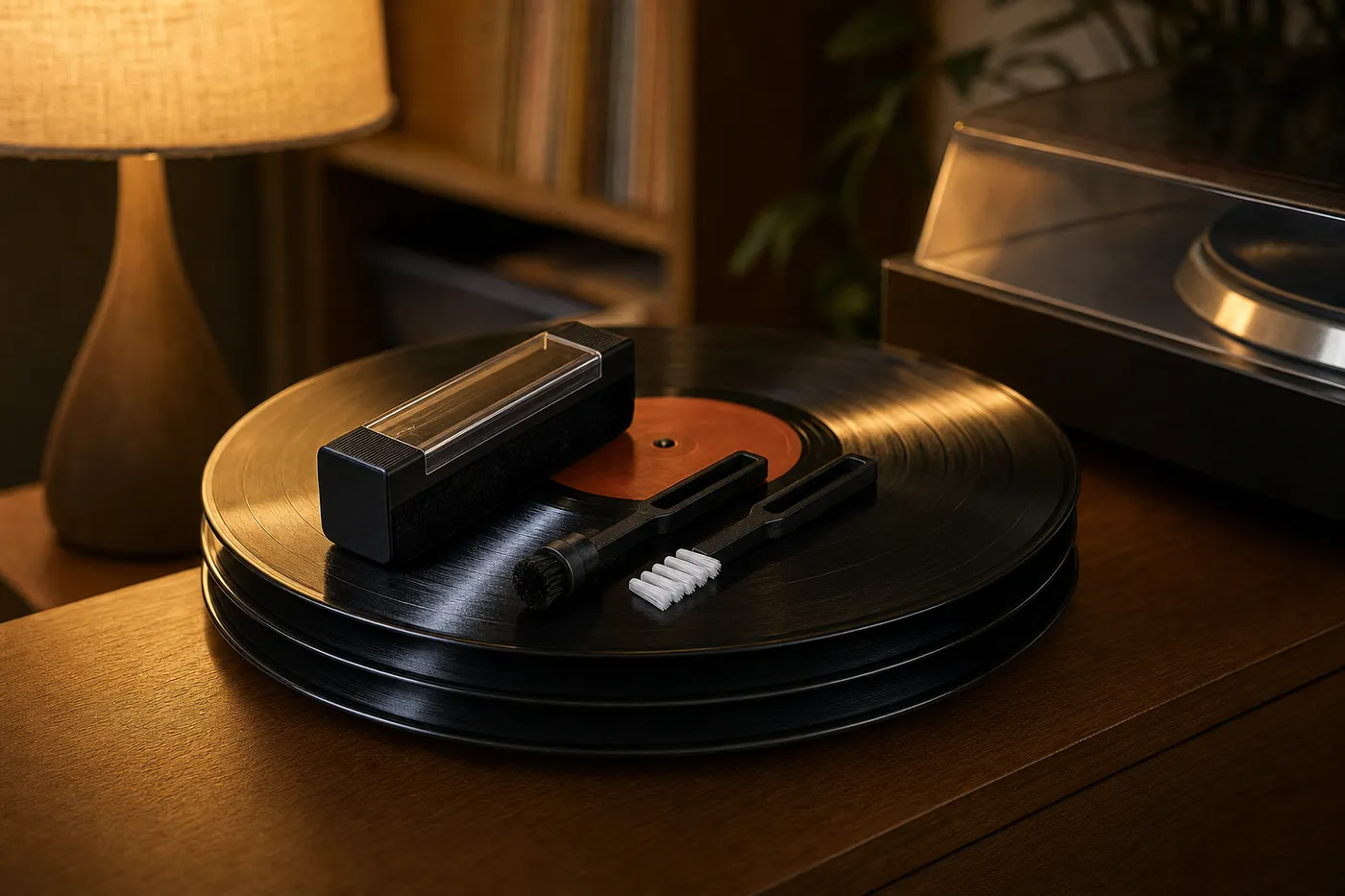
A record is a soft plastic disc a little over 12 in (30 cm) across, held flat by nothing except its own stiffness. Leave it under weight, warm it unevenly, or let it lean at an angle for a season, and it takes on a shape it will not give back. Warp is not a rare accident that happens to unlucky collections. It is the predictable result of storing records in ways that feel perfectly reasonable at the time.
Storage is also the quiet half of record cleaning. Every hour a disc spends in the wrong sleeve is an hour it spends collecting paper fiber and holding a static charge. The collectors who complain that their records get dirty again three days after a wash are almost always describing a storage problem rather than a cleaning problem. Fix the shelf and the brush has a much easier job.
Vertical always, stacked never
"Shelve discs such as LPs, 45s, and 78s vertically and in their sleeves. Do not stack discs on top of one another."
Flat stacking concentrates the weight of every record in the pile onto the one at the bottom. Vinyl creeps under sustained pressure, so the bottom disc takes on the shape of whatever is under it, including the ridge of a label. A stack of twenty is enough to do it over a few months of a warm summer.
Leaning is more common and more insidious because it looks fine. A half-empty crate lets the outer records tip toward the gap, and gravity does the rest at a few degrees a month. The fix is mechanical rather than fussy: fill the row, use a divider or a bookend, and never let a section relax into a slope. Snug means the records support each other, not that you have to force one in with your thumb.
| Storage habit | What it does over time | What to do instead |
|---|---|---|
| Flat stacks on the floor or a table | Sustained pressure deforms the discs at the bottom of the pile | Upright rows on a shelf, spine out |
| Half-empty crates | Outer records lean and set into a curve | Fill the row or use dividers and bookends |
| Rows packed hard | Sleeve seams split and covers get ring wear | Snug contact, no force needed to remove a record |
| Deep shelves two rows front to back | The back row is invisible, so it never gets checked or played | One row deep, about 13 in (33 cm) of clear depth |
| Shelves with no support in the middle | The shelf itself sags under the load and tilts the records | Short spans, thick boards, weight close to the uprights |
Weight is the part people underestimate. A full 12 in (30 cm) row is heavy enough that furniture designed for paperbacks will bow within a year, and a bowed shelf turns an upright row into a leaning one. Short spans and stout boards solve it permanently.
Temperature, humidity, and light
(13-21°C) and 30-55% relative humidity, the range federal audio storage guidance gives for discs, with the instruction that it should not fluctuate
Stability outranks the target. A room that sits at 72°F (22°C) year round is kinder to a collection than one that swings from 60 to 85°F (16 to 29°C) between seasons, because every cycle of expansion and contraction works on a disc that is already under mechanical stress from its neighbors. This is the argument against attics, garages, and the top of a radiator alcove, and it is also the argument against an unheated storage unit.
Humidity matters at both ends. Damp air feeds mold on paper sleeves and jackets, and mold on a jacket eventually becomes mold on the record. Very dry air makes static worse, which is a direct dust problem. Sunlight is the simplest one to handle: an afternoon of direct sun through a window can warm a disc enough to warp it, so shelves go on the wall the sun does not reach.
Sleeves, the layer that touches the record
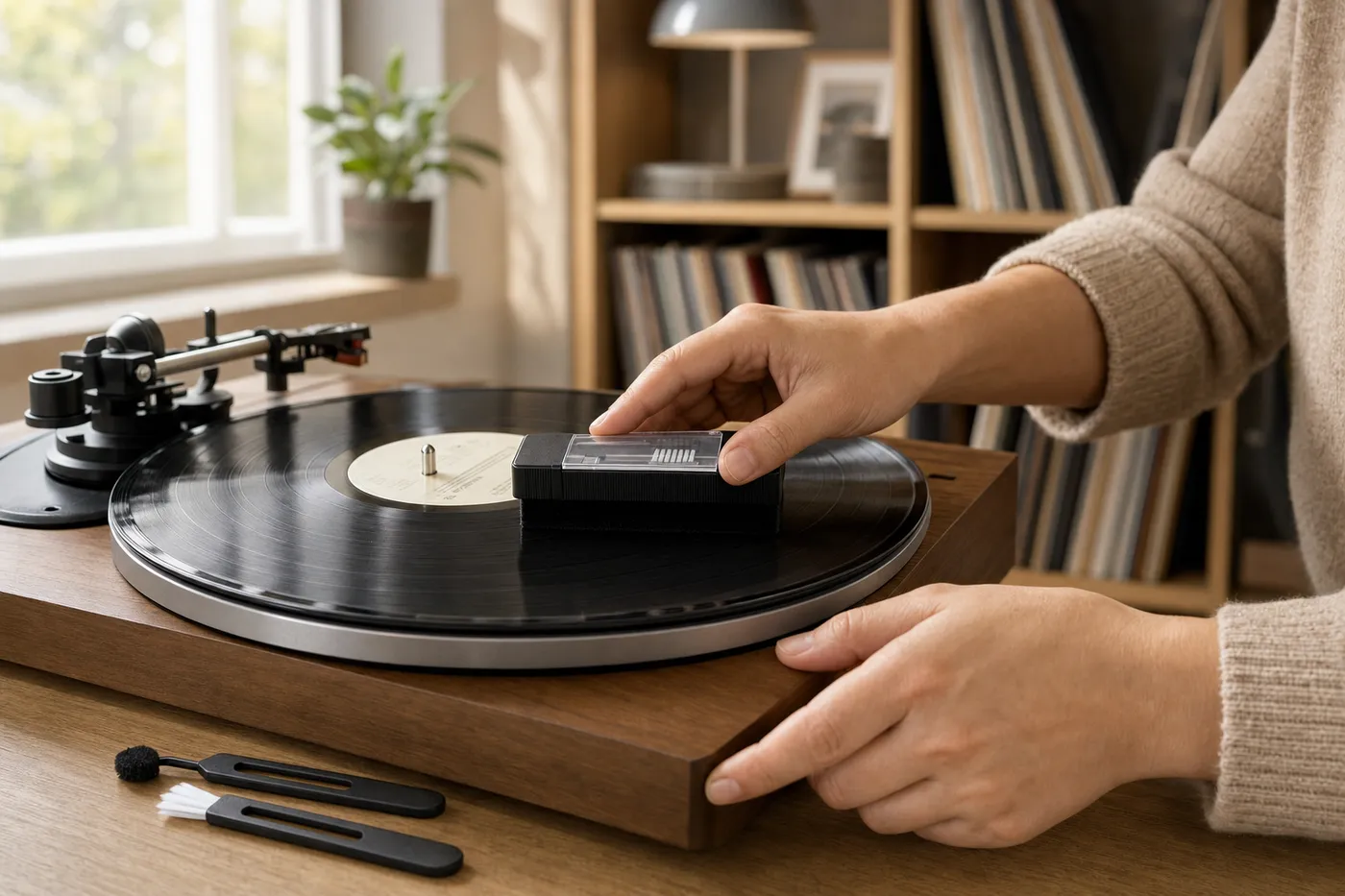
Plain paper is abrasive at the scale that matters here, and it sheds fiber. Every time a record slides in or out, the surface takes a light scuff and the sleeve leaves a little of itself behind. Anti-static poly-lined inners give the disc a smooth surface to travel across and generate far less charge on the way out, which is the whole point.
"The electrostatic nature of vinyl increases the attraction of dust to the surface of the disc", which is why the sleeve you choose changes how dirty a record gets
— IASA TC-04, section 5.3, 2009
A collection you are upgrading gradually has a natural order. Inner sleeves come first because they touch the record. Outer sleeves come second because they protect resale value rather than sound. Dividers and bookends come third because they are what actually keeps a row upright. Nothing here is expensive, and the first step is the only one that changes how your records sound.
Why clean storage means less cleaning
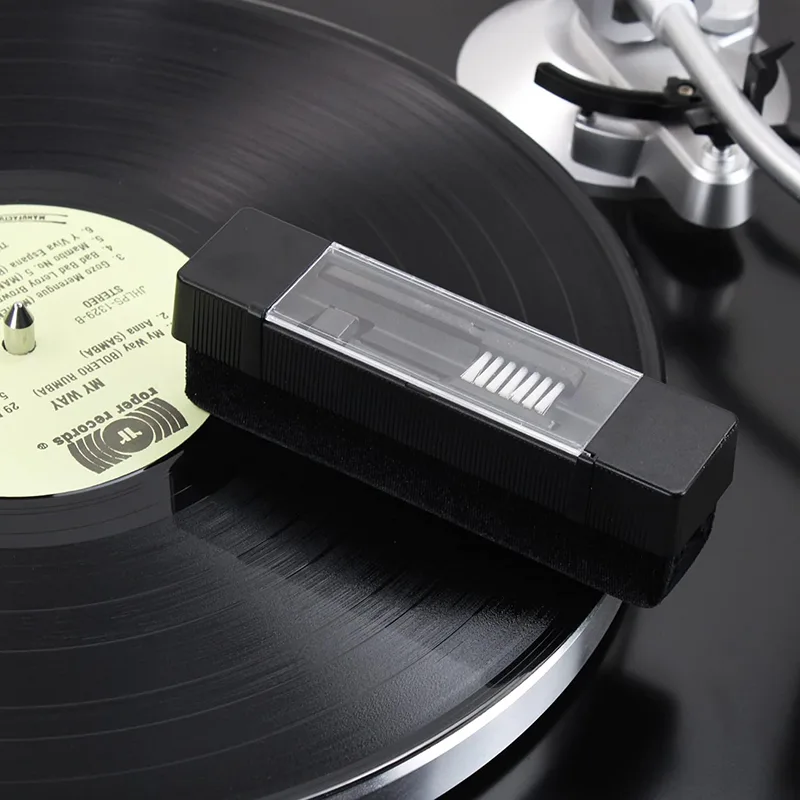
This is where a brush earns its place in the routine. The velvet block in our three-piece set is a firm pad wrapped in black velvet, about 4.9 in (12.5 cm) long, with a clear sliding cover that keeps the velvet clean while it sits on the shelf. That cover is the part that matters for storage: a brush left face up in a dusty room becomes a dust applicator. The set also holds a stylus brush and a white nylon detail brush that re-combs the velvet when it loads up.
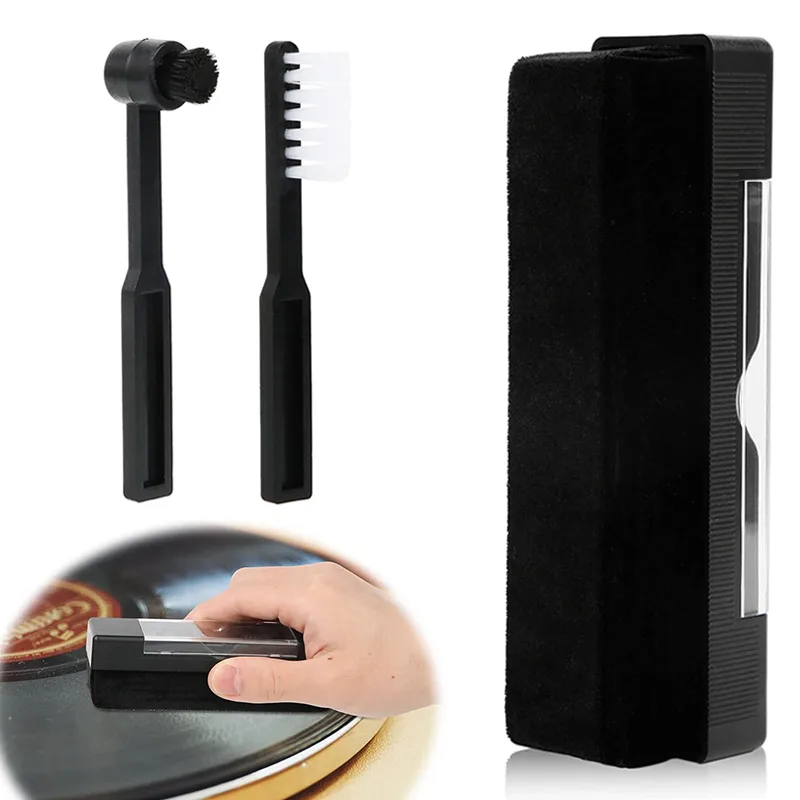
Across the 47 written reviews in the buyer feedback record (July 2026), our count found dusting effectiveness was the single most mentioned theme at 9 mentions, or 19% of written feedback. Four buyers, 9%, wrote in to say the block is a pad rather than a set of bristles. The verified buyer feedback sits on the reviews page.
If a record still sounds noisy after brushing, storage was not the problem and it needs a wash. The three levels of cleaning, and when each one applies, are in how to clean vinyl records. For the everyday version, the vinyl record care routine lays the whole thing out as a checklist.
Short answers
Is it ever acceptable to store records flat?
For a short move or a shipment, yes, in small stacks and for days rather than months. As a storage method it is the main cause of warped records in home collections, because the discs at the bottom carry the weight of everything above them continuously.
What temperature is too warm for vinyl?
Federal audio guidance caps the recommended range at 70°F (21°C). Records survive normal room temperature above that, but sustained heat plus pressure from neighboring discs is what produces warp, and direct sunlight through a window can exceed anything your thermostat reads.
Should I keep the original paper inner sleeve?
Keep it if it carries artwork, lyrics, or credits, and file it inside the jacket alongside the record rather than around it. The record itself goes in an anti-static poly-lined sleeve. You lose nothing from the package and the playing surface stops rubbing against paper.
Give the shelf a brush that stays clean
Good storage is most of the work. The rest is a brush that lives with the records and does not collect dust between uses. Our set is three pieces, one job each, and the velvet block has a sliding cover for exactly that reason. See the full set on the record cleaning kit page, the static side of it on the anti-static record brush page, or the small one on the stylus brush page.
More guides: all Tonebrush guides · carbon fiber vs velvet · cleaning a record player needle · how we test · about Nick Talbot