How to Clean a Record Cleaning Brush: The Two-Minute Comb-Out
Updated on
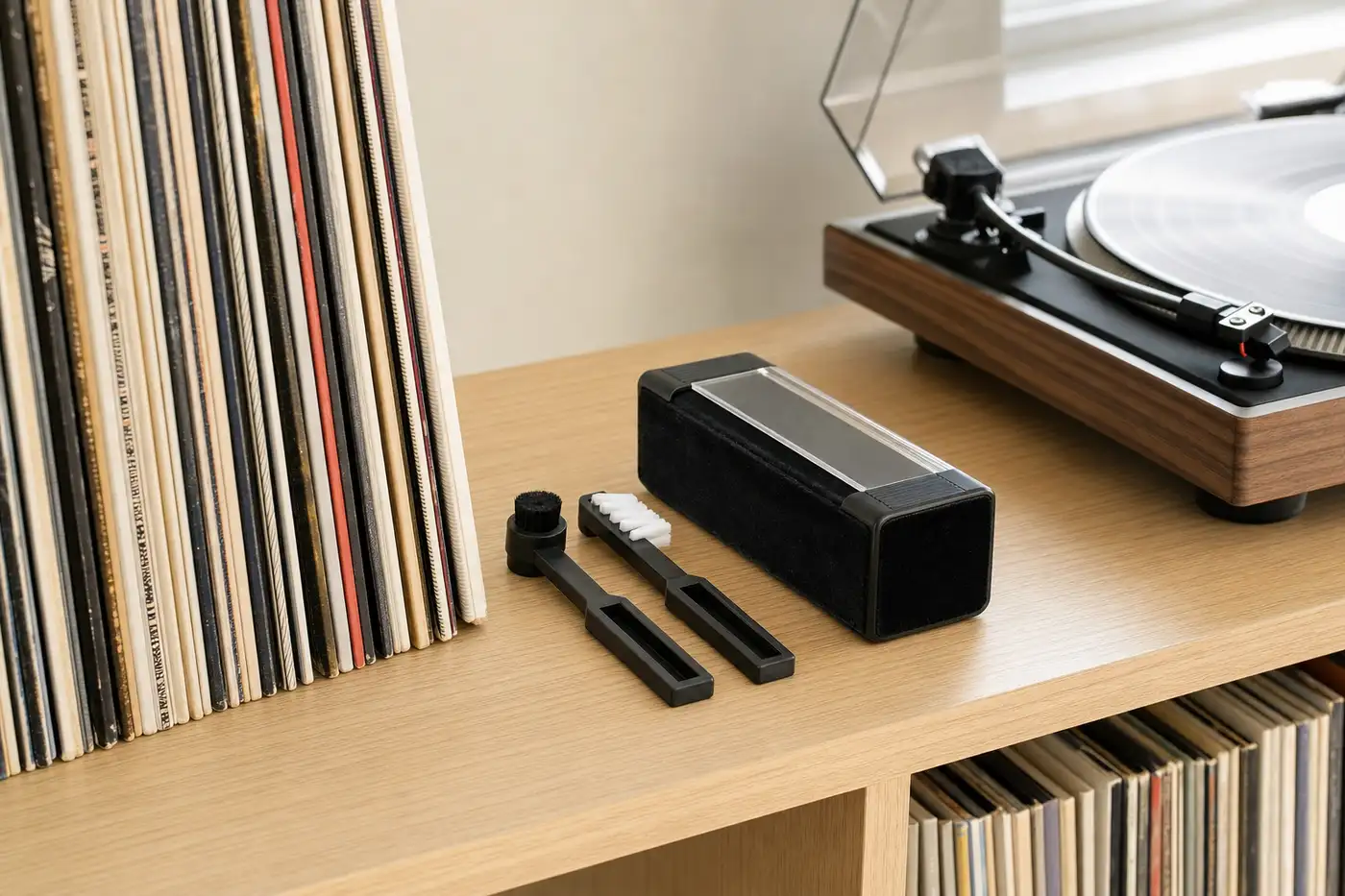
A record brush is the only cleaning tool in the house designed to keep what it takes away. A cloth gives its load up in the wash; a vacuum sends it to a bag. A velvet pad holds the dust between its fibers, a few inches from your records, until somebody takes it out. That is the design, not a flaw in it.
Almost nobody empties it. The block sits beside the deck, gets used before every side for a year, and is never combed out. By then the face reads grey under a lamp instead of black, and the tool has turned around: it sets down a little of what it lifts. That is the one real failure mode a velvet brush has, and it is preventable.
Three signs the velvet is full
Straight down, black velvet holding grey dust looks like black velvet, which is why the job gets skipped for a year at a time. Tilt the block so a lamp rakes across the face, the same trick that finds fingerprints on a record, and a loaded pile scatters that light and reads flat. A clear pile reads deep black with a visible grain.
The second sign shows up on the record. A pad holding all it can stops accepting more, so the dust it meets rides in front of the face and is set down again at the end of the pass, as a thin arc near the run-out. Collectors blame the sweep for that line; the load in the pad put it there.
The third is fastest. Draw a thumb across the face: clean velvet has drag and direction, a packed pad feels slick, because your thumb is riding on what the velvet collected. A few sides a week and a monthly comb keeps a pad ahead of the dust, which is where it sits in our vinyl record care routine.
Where the dust goes inside the pile
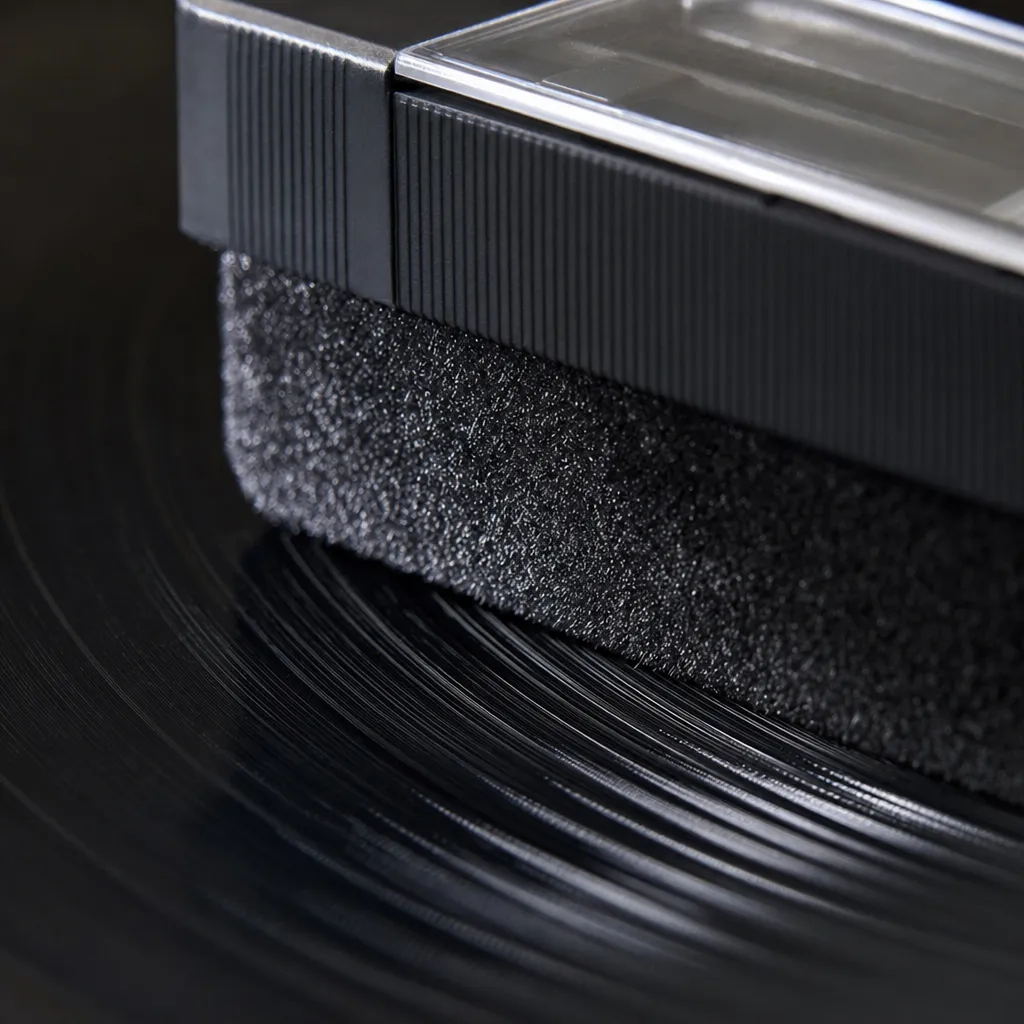
What you are storing in there is not lint. The fraction of household dust that matters on a record is small enough to sit inside a groove rather than bridge across it.
Diameter at and below which the EPA classes indoor particulate as inhalable, small enough to sit inside a groove
Put that next to the thing that rides over it. A stylus works at a scale where one particle is a large object, not a speck, which is why a brush that redeposits is a real problem.
(15-25 µm) tip radius range archives use to replay microgroove LPs, which is the same order of size as ordinary dust
— IASA TC-04, section 5.3, 2009
The refill rate has its own cause: vinyl attracts dust rather than merely catching it, so the surface you just cleared starts recruiting a new load.
"The electrostatic nature of vinyl increases the attraction of dust to the surface of the disc"
— IASA TC-04, section 5.3, 2009
None of that argues for sweeping less. It argues for emptying the pad on a schedule, because the pile has a finite amount of room to work in. What the velvet face does on the record itself is on the anti-static record brush page.
The two-minute comb-out
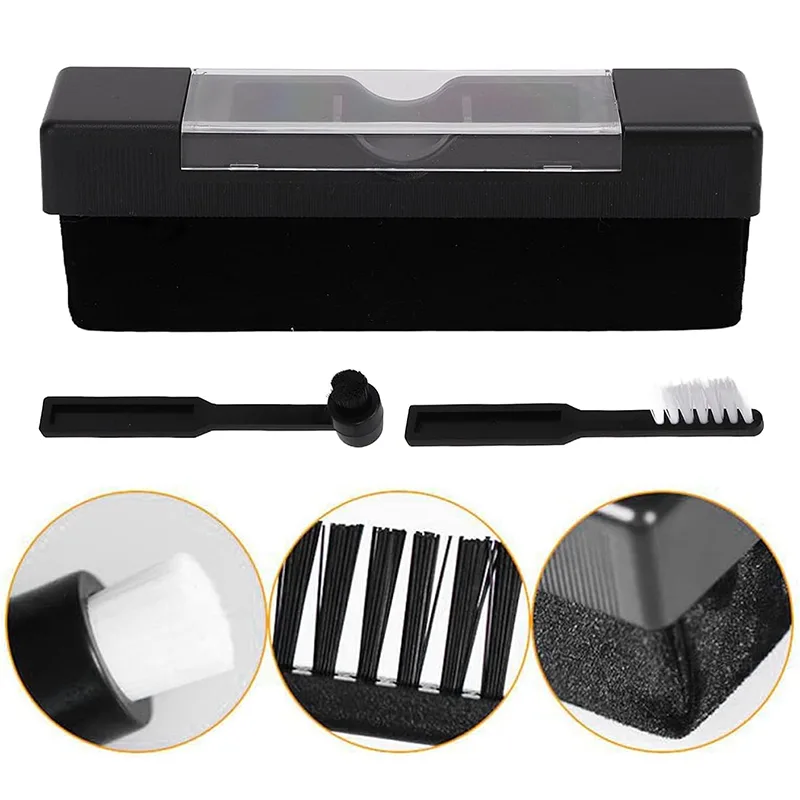
Pick up the right brush first, because the set holds two small ones and in a photograph they look interchangeable. The stylus brush is the angled piece with the round head of black bristles. The straight piece with white nylon bristles is the detail brush, and combing the velvet is its only job. They are not swappable in either direction: the nylon brush never goes near a cartridge, and the stylus brush never goes near the pad.
Everything you lift out has to land somewhere, and the worst places are the turntable and the records, so work over a bin. The stroke is short, firm and one-directional, across the face from end to end rather than scrubbed back and forth. On a neglected pad the load comes out as a grey line building ahead of the bristles. Keep going until a pass produces nothing, then run the brush once along the pile so the fibers lie as they were made to, and slide the cover back on. Three seconds at the end of a session keeps a pad from ever getting bad; two minutes brings back one left a year unattended. All three pieces are laid out on the record cleaning kit page.
Washing the pad, and when it is needed
Being washable is an advantage a pile has over a row of fixed filaments, and one of the points in our comparison of carbon fiber versus velvet record brushes. It is also reached for too early: if the face is grey and nothing has been spilled on it, that is a combing job.
When it is warranted, treat it as cleaning a face rather than laundering an object. Do not submerge the block, because the pad is bonded to a body that stores the stylus brush inside it. Wet the pile under lukewarm running water, work a trace of mild detergent through it along the grain, then rinse until the water runs clear. Detergent left in a pile behaves like detergent left in a groove: it attracts the next round of dirt and holds it.
Drying is where pads get wrecked. Dry it pile-upward in open air at room temperature, not on a radiator and not under a hairdryer, and dry it completely. A pad that goes back to work faintly damp picks up paper fibers from the first sleeve it meets and leaves moisture on vinyl, the opening move of every problem how to store vinyl records prevents.
Five things that ruin a velvet pad
| Never do this | What it does | Do this instead |
|---|---|---|
| Solvent, alcohol or spray cleaner on the pad | Puts a chemical into a tool whose only load is dust, on fabric bonded to a plastic body. | Lukewarm water, a trace of mild detergent, rinsed clear. |
| Putting it away damp | Moisture under a closed cover stays there, and the next record gets the damp and the paper fibers. | Dry it fully in open air, pile up and cover off, then close it. |
| Scrubbing back and forth on the record | Friction adds charge, and a dragged pad turns loose dust into an abrasive crossing the grooves. | Rest it flat, let the platter turn under it, then lift straight up. |
| Using the block as a duster on the plinth, mat or speakers | Everything it collects there joins the same pile, and arrives on the next record you sweep. | Keep the block for discs, and wipe the deck with a separate cloth. |
| Storing it face down and uncovered | An open pile fills up while doing no work at all, so the brush starts each session part loaded. | Slide the clear cover over the velvet whenever it is not in your hand. |
The last row decides how often the other four matter. The clear sliding cover is a handle when you sweep and a lid when you do not, and a pad that lives under it arrives at the next session in the state you left it.
When a pad is past combing
The distinction that matters is between a pad that is loaded and one that is damaged. A loaded pad is maintenance and comes back completely. A crushed, contaminated or lifted pad is not, and no work on it changes the result. What gets a pad there is the table above rather than mileage: kept covered, kept dry, kept off the plinth and combed on a rhythm, a velvet face goes on working for years.
If yours has reached that point, the replacement is the whole set rather than a pad, because the piece that keeps the velvet alive lives in the same box as the velvet. The two-set option answers the situation people actually have: one block beside each turntable, or one for a second listening room, so neither deck borrows the other's brush and doubles its load. Buyers wrote about the pad more than any other part of the set, counted line by line on the reviews page.
Short answers
Can you wash a velvet record cleaning brush?
Yes, with lukewarm water and a trace of mild detergent worked through the pile and rinsed clear. Do not submerge the whole block, and let it dry completely in open air before it goes near a record. For ordinary dust, combing is faster and better.
How often should a record brush be cleaned?
Three seconds with the detail brush at the end of each listening session, and a proper comb-out monthly if you play a few sides a week. Working through a crate of secondhand records, it needs one after every session, because used discs load a pad quickly.
Can the stylus brush be used to comb the velvet?
No. The angled brush with the round black head is for the diamond and nothing else; the straight brush with white nylon bristles is for the velvet and nothing else. Keeping them to their own jobs stops grit from the pad ever reaching a cartridge. The stylus method is in how to clean a record player needle.
The third piece is the one that keeps the other two working
Most people meet a record brush as a single object and leave the small white one in the box. It is the piece that makes the block last: a velvet face empties in seconds when something is built to empty it, and stays full for a year when nothing is. The Tonebrush set ships all three together for that reason: the velvet block, the stylus brush and the detail brush, in one box.
More guides: all Tonebrush guides · how to clean vinyl records · about Nick Talbot